
Swirl Switch Dual-Chamber Empty Disposables: Flavor Switching, Coil Design and Oil Compatibility
Dual-chamber “switch” disposables sell because they feel like two SKUs in one: buyers can offer variety without doubling shelf space. But for wholesalers, the real win is operational—when the hardware platform is consistent, you reduce returns, support tickets, and re-shoot costs across restocks. This guide explains how switching works, what coil specs actually change, and how to evaluate oil compatibility (the part most buyers get wrong).
What you’ll learn
Switch mechanics, ceramic-coil considerations, and a compatibility checklist you can reuse per lot.
Who it’s for
Distributors and B2B buyers ordering dual-chamber hardware for multi-variant programs.
Why it matters
Compatibility mistakes happen at the inlet/coil interface—fix that, and everything else gets easier.
1) What a dual-chamber “switch” disposable really is
A dual-chamber disposable is a single device that contains two separate chambers (often called “tanks”) so a buyer can offer two variants in one shell. The “switch” part is the user-facing control that selects which chamber feeds the heating path (or in some designs, which coil system is active). For B2B programs, the takeaway is simple: two chambers = more SKUs without more shelf space but also = more variables to QC.
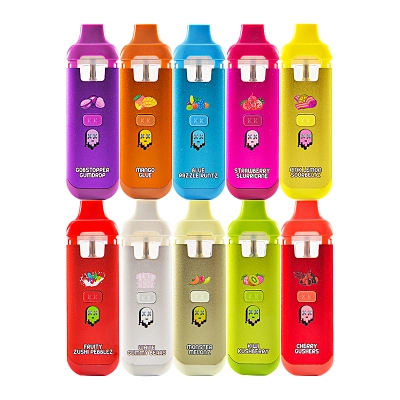
The Swirl Switch platform on Lueciga is presented as a 2ml class device with an LED screen, dual chamber switching, a ceramic coil around 1.4Ω, and a 4×1.6mm oil inlet (oil hole size). Those are not just “specs”—they’re your compatibility guardrails when you evaluate concentrates by thickness and flow behavior.
2) Flavor switching: common architectures and what to test
Architecture A: single mouthpiece, switched feed
In this design, the device uses one mouthpiece path with a switch that routes airflow or feed from Chamber A or Chamber B. The benefit is a clean, unified top profile. The risk is “cross-talk” (residual vapor or small mixing) if the internal path is shared.
Architecture B: dual feed, shared UI
Here, each chamber has a more distinct internal path, but the screen/UI is shared. This can reduce cross-talk, but it raises the importance of alignment tolerances: any mismatch between chamber outlet and coil inlet can show up as inconsistent draw.
What to test (fast, B2B-friendly)
- Switch feel: consistent tactile “click” and no mushy mid-position.
- Indicator logic: screen changes clearly when you switch chambers (no ambiguous state).
- Draw symmetry: Chamber A and B should feel similar in restriction unless intentionally tuned.
- Carryover: after switching, the first pull shouldn’t taste “half-and-half” for multiple hits.
3) Coil design: why ceramic + resistance matters to consistency
Ceramic coil: why buyers like it
Ceramic heating elements are commonly used in thick-oil hardware because they can provide stable heating and a smoother perception of flavor. From a procurement standpoint, the advantage is repeatability: ceramic structures tend to be less forgiving of sloppy assembly, which means a well-made ceramic platform often shows fewer “random” defects once your supplier process is stable.
Resistance is not a marketing number
Resistance (for example, 1.4Ω on the Swirl Switch spec sheet) influences how the device behaves under load—how quickly it reaches operating temperature, how it responds to thick vs thin materials, and how stable performance feels over repeated puffs. For dual-chamber devices, consistency matters twice: you want both chambers to feel “in-family.”
| What to ask | Why it matters | What to verify |
|---|---|---|
| Coil type (ceramic vs other) | Heat stability and wicking behavior differ by structure | Supplier confirms coil material + consistent batch sourcing |
| Resistance target (e.g., 1.4Ω) | Changes responsiveness and perceived “smoothness” | Spot-check variance across samples (not just one unit) |
| Inlet match (oil hole geometry) | Flow must match viscosity; mismatch causes dry hits/clogs | Confirm inlet size and finish quality (burr-free) |
4) Oil compatibility starts at the inlet (not marketing claims)
When buyers complain about “clogging,” “weak hits,” or “burnt taste,” the root cause is often a mismatch between the material’s flow properties and the hardware’s feed path. The Swirl Switch spec highlights an oil hole size of 4×1.6mm. In dual-chamber devices, that inlet geometry matters even more because each chamber may behave slightly differently due to manufacturing tolerances and how the internal seals sit.
What “compatible” should mean (in B2B terms)
For a wholesale program, compatibility should be defined as: stable flow predictable heat response minimal residue buildup at the inlet consistent chamber-to-chamber behavior. If a supplier can’t explain compatibility this way and falls back on vague labeling, you’re buying risk.
5) Viscosity & flow: practical compatibility signals
Without getting into “recipes,” you can still make compatibility decisions by focusing on observable properties: thickness at room temperature, how quickly the material moves when the device is warmed by typical handling, and whether it tends to leave heavy residue on small passages. In dual-chamber designs, you also want oils that behave similarly across time—because the two chambers will not always be used equally.
3 signals that your oil-hardware match is healthy
- Startup consistency: performance is similar on first use after rest, not “blocked” until warmed.
- Stable draw over time: draw resistance doesn’t steadily increase as residue builds.
- Even chamber behavior: Chamber A isn’t reliably “better” than Chamber B in the same lot.
2 signals you should treat as a red flag
- Hard carryover + mixing: switching always produces multiple “mixed” pulls, suggesting shared path residue.
- Rapid inlet fouling: performance drops quickly even with normal use patterns, indicating mismatch at feed geometry.
6) Receiving QC: a repeatable 10-minute routine
Your receiving team doesn’t need lab tools—just a consistent routine and “golden sample” discipline. For Swirl Switch style dual-chamber screen devices, a 10-minute sampling routine per lot can prevent the most expensive disputes.
Suggested sampling routine (B2B practical)
- Screen boot check: no dead segments; chamber state is readable.
- Switch action check: consistent travel and state change across samples.
- Port + charge behavior: Type-C port seats properly; charging indicator is consistent.
- Cosmetic audit: look for scratches on screen window and finish rub under one fixed light.
Pro tip: store a “golden sample” for each edition and compare new lots against it—especially for screen brightness, bezel alignment, and switch feel. A golden sample turns “it looks different” into a measurable acceptance decision.
7) B2B ordering tips: how to prevent lot drift
Lock the platform specs first
Separate platform specs (capacity class, battery class, resistance target, inlet geometry) from cosmetics (colorways, labels, packaging art). With dual-chamber devices, platform drift is what causes compatibility surprises.
Ask for chamber symmetry expectations
Put it in writing: the device should not ship if one chamber consistently behaves differently from the other. This pushes the supplier to tighten assembly checks on seals and feed alignment.
Buy fewer “unknowns” at once
If you’re ordering a new edition, keep the first lot smaller and scale after QC confirms stability. Dual-chamber is a premium feature—don’t treat it like a generic shell purchase.
8) Site routing: how to cluster this content for SEO
For topical authority, route readers from brand hub → category listing → technical explainer. Your 3 internal links below do exactly that: brand hub (Swirl), product listing (Swirl Disposable Vape), and a broader category cluster page (dual chamber vape).
Start here: Swirl
Browse the Swirl collection: Swirl Disposable Vape
See the broader category cluster: dual chamber vape
Summary: Dual-chamber “switch” disposables win when switching is crisp, coil specs are stable, and compatibility is evaluated at the inlet/coil interface—not by buzzwords. Use the QC routine and ordering tips above to keep your B2B program consistent across restocks.



0 Comments